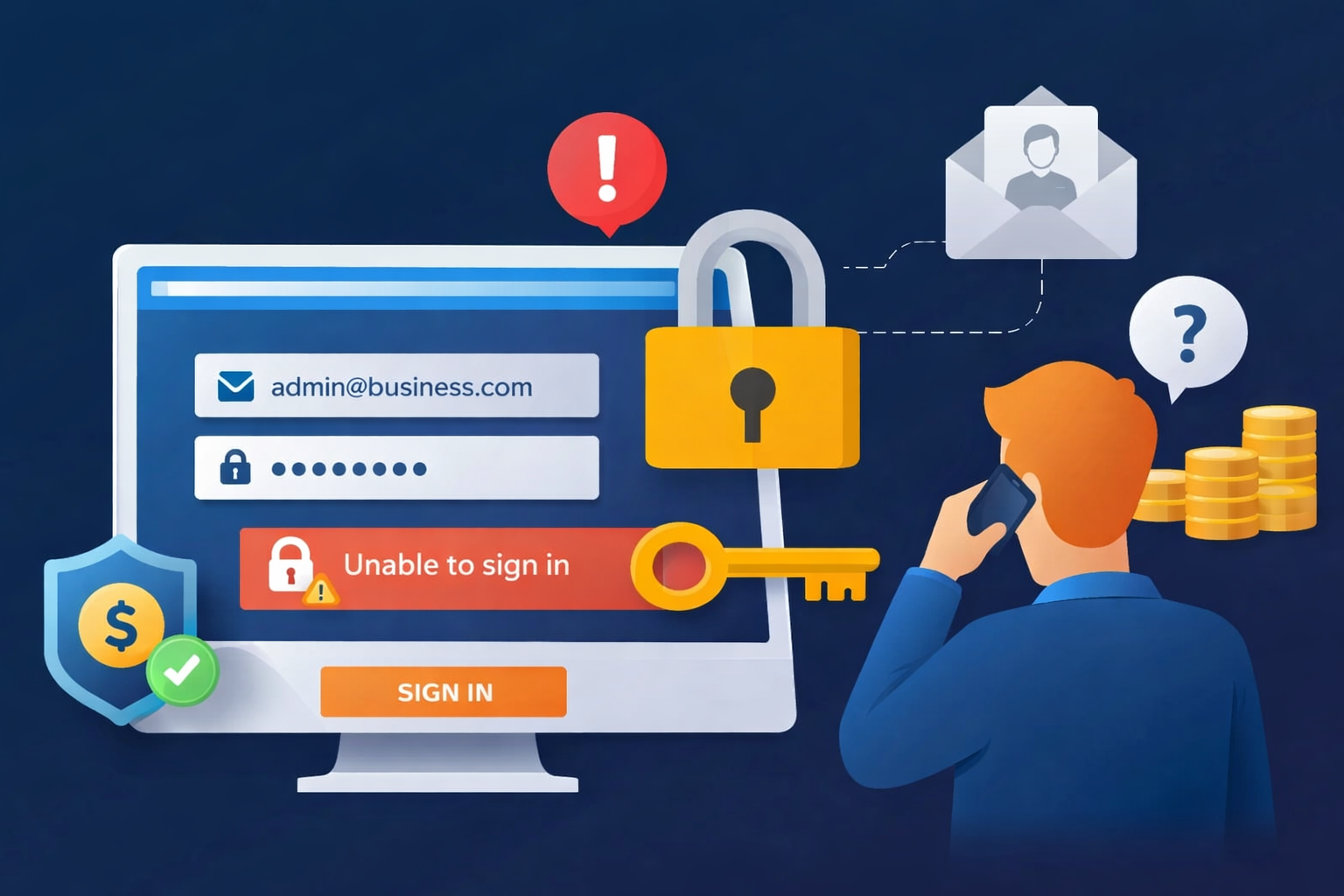
A simple login change that locked a business out of its own money
A small business owner called after being unable to access their online payments system.
No alerts. No breach notification. No warning.
Just a login failure on a normal workday.
They assumed it was a temporary issue.
It was not.
What actually happened
The business used a shared admin email address to manage access to their payment platform.
Over time:
Multiple people had access to that inbox
Password resets went unnoticed
Ownership of the account was unclear
Eventually, a security update triggered a verification request.
The verification email went to the shared inbox. No one acted on it. Access was locked automatically.
The platform was doing exactly what it was designed to do.
The business was suddenly unable to receive payments.
Why this caught everyone off guard
From the business perspective, nothing had changed.
They were still using the same platform. Transactions had worked the day before. No one intentionally modified anything.
But one assumption was quietly wrong.
They assumed shared access was harmless.
The real issue was not the platform
The payment system did not fail. Security controls did not fail.
What failed was ownership.
No single person was clearly responsible for:
Account recovery
Security notifications
Verification actions
When responsibility is shared, accountability disappears.
Why this scenario is more common than people realize
This pattern shows up everywhere:
Shared email accounts
Shared admin credentials
Shared cloud storage ownership
Shared vendor portals
It starts for convenience. It stays because nothing breaks immediately.
Until it does.
The broader lesson for small businesses
Security failures often look like technical problems.
They are usually decision problems.
Before asking whether a system is secure, ask:
Who owns it
Who receives alerts
Who is responsible when access is lost
If those answers are unclear, risk already exists.
How this could have been avoided
This situation did not require expensive tools.
It required:
A named owner for the account
Individual access instead of shared credentials
A documented recovery path
Small changes. Big difference.
How HXD approaches situations like this
At HXD Technologies, we focus on removing silent risks before they turn into operational outages.
That means:
Eliminating shared access where it does not belong
Making ownership visible
Designing systems that still work when people change roles
Reliable IT is not about reacting faster. It is about making fewer mistakes invisible.
That is what real security looks like in practice.